


Have you ever watched your baby go still and wide-eyed at fairy lights or sunlight dancing across the ceiling? Then you have already seen light play in action. In fact, light is one of the first things babies notice. That makes light play for babies one of the simplest kinds of sensory play. It is also a big part of what we do at Little Senses, and it’s even in our tagline: “Light up your baby’s world”.
So what is going on when your little one is captivated by a glowing ball? Is light play just pretty, or does it help with development? Here is what light play for babies and toddlers can offer, some simple ideas to try at home, and how to keep it safe.
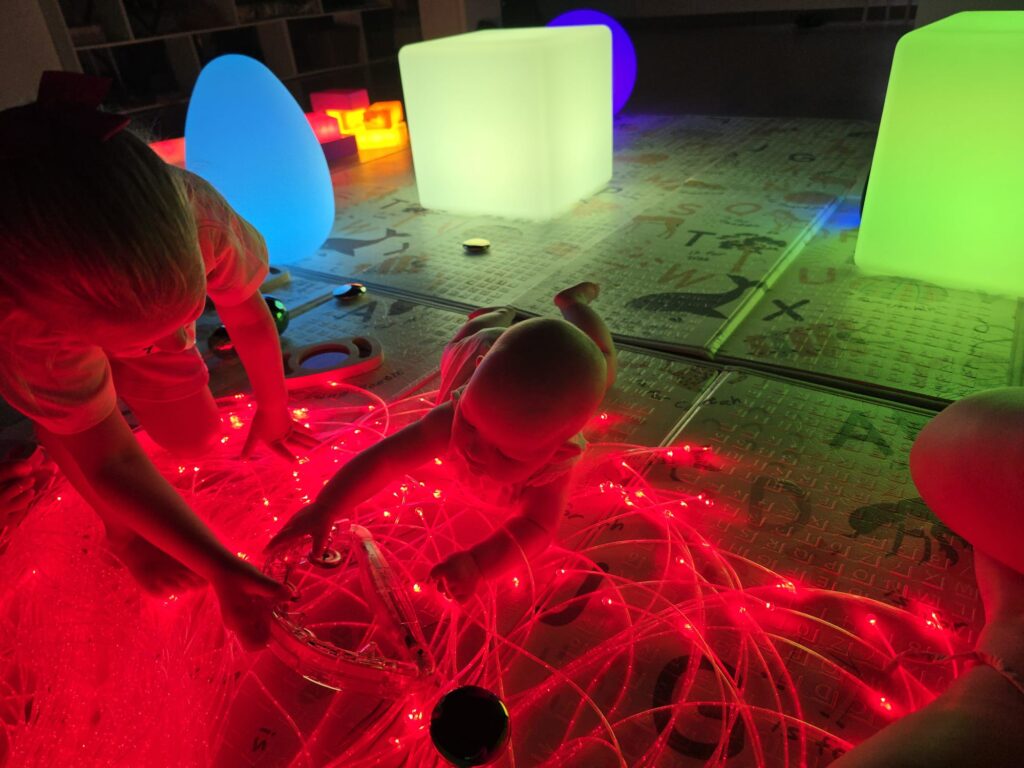
Why are babies so drawn to light?
A newborn’s vision is still developing. In the early weeks, babies see best close up, roughly 20 to 30 cm away. That’s about the distance to your face during a feed. They are also most interested in strong contrast between light and dark. A soft glow in a dim room is about as high-contrast as it gets, so young eyes find it easily.
Vision then changes quickly over the first months. According to the American Optometric Association, babies typically start to follow moving objects and reach for things at around three months. By around five months, their eyes are working together to judge depth and their colour vision is generally good. Every baby gets there in their own time. Light play for babies is simply a gentle way to give those developing eyes something interesting to do.
The benefits of light play for babies and toddlers
1. Practising focus and visual tracking
When a light moves slowly across your baby’s view, their eyes have to find it and follow it. That is good practice for the eye muscles. It also helps the brain learn to make sense of what the eyes see. Slow movements work best. Try rolling a glowing ball gently across a mat, or moving a soft light in a slow arc.
2. Building attention and concentration
Glowing and colour-changing objects hold a baby’s attention in a way many toys don’t. Those few seconds (or minutes) of focused looking are the very beginnings of concentration. Then, each time you come back to the same light, you may notice your baby’s attention stretching a little longer.
3. Calm and emotional regulation
A dim room with soft, slowly changing light can feel cosy and safe, for babies and grown-ups alike. A short, calm light routine can help too. Try dimming the main light and switching on a gentle glow before naps. It’s a simple signal that it is time to wind down. Light play doesn’t have to be exciting to be useful. Sometimes the best thing it offers is a quiet moment together.
4. Cause and effect
Pressing a light-up toy and watching it change colour teaches a powerful early lesson: “I did that!” Learning that their actions make things happen is a key building block, and light gives instant, visible feedback.
5. Reaching, grasping and moving
Light also gives babies a reason to move. Babies who aren’t crawling yet will bat at and reach for glowing fibre optic strands. This builds hand-eye coordination. Meanwhile, crawlers will set off across the room towards a glow. Toddlers love to carry, stack and fit together light-up blocks.
6. Early communication and language
Of course, communication starts long before words. When you and your baby look at the same glowing light, you are sharing attention. That is one of the foundations of language. So talk about what you can both see: “Ooh, blue!”, “Light on, light off”, “Up it goes!” Simple, repeated words (and signs, if you use them) help your baby link words with what they see.
7. Early science and maths for toddlers
As toddlers grow, light becomes a brilliant way to explore how the world works. They can watch colours mix as coloured shapes overlap, and make shadows grow and shrink with a torch. Sorting glowing blocks by colour, counting as they stack and talking about bigger, smaller, more and fewer all count too. This is early science and maths, learnt through play.
8. Daylight and your baby’s body clock
However, not all of the benefits of light come from toys. Babies aren’t born with a settled body clock, and natural light helps them learn the difference between day and night. A 2004 study from Liverpool John Moores University looked at babies aged 6 to 12 weeks. Those who slept well at night had around twice as much early afternoon light as those who slept less well. The study showed a link rather than proof, but it fits with familiar advice. In short, get plenty of daylight during the day, and keep night feeds dim and calm. A walk in the shade after lunch counts, as young babies should be kept out of direct sun.
Light play ideas to try at home
Light play for babies doesn’t need special equipment. Choose cool, battery-operated LED lights, keep sessions short and follow your baby’s lead.
For babies who aren’t crawling yet
- Follow the light: in a dim room, slowly move a glowing toy across your baby’s view, 20 to 30 cm away. Pause and let them find it again.
- Tummy time glow: a light-up toy just in front of your baby gives them a reason to lift their head.
- Shadow show: shine a lamp onto a plain wall and make slow hand shapes for your baby to watch. Keep the lamp behind your baby so it never shines in their eyes.
- Glowing sensory bottle: fill a clear plastic bottle with water and glitter and glue the lid shut. Hold a torch behind it to make it glow.
For crawlers and toddlers
- Glow den: drape a blanket over a table or chairs and add a few battery tea lights. A dark den makes any light feel magical.
- Torch hunt: hide a few favourite toys around a dim room and find them together with a torch. Older toddlers love being in charge of the torch. Show them how to point it at the floor and walls, not faces.
- Colour windows: stick coloured cellophane on a sunny window and watch the colours move across the floor during the day.
- Stack and glow: build towers with light-up blocks, then knock them down and start again.
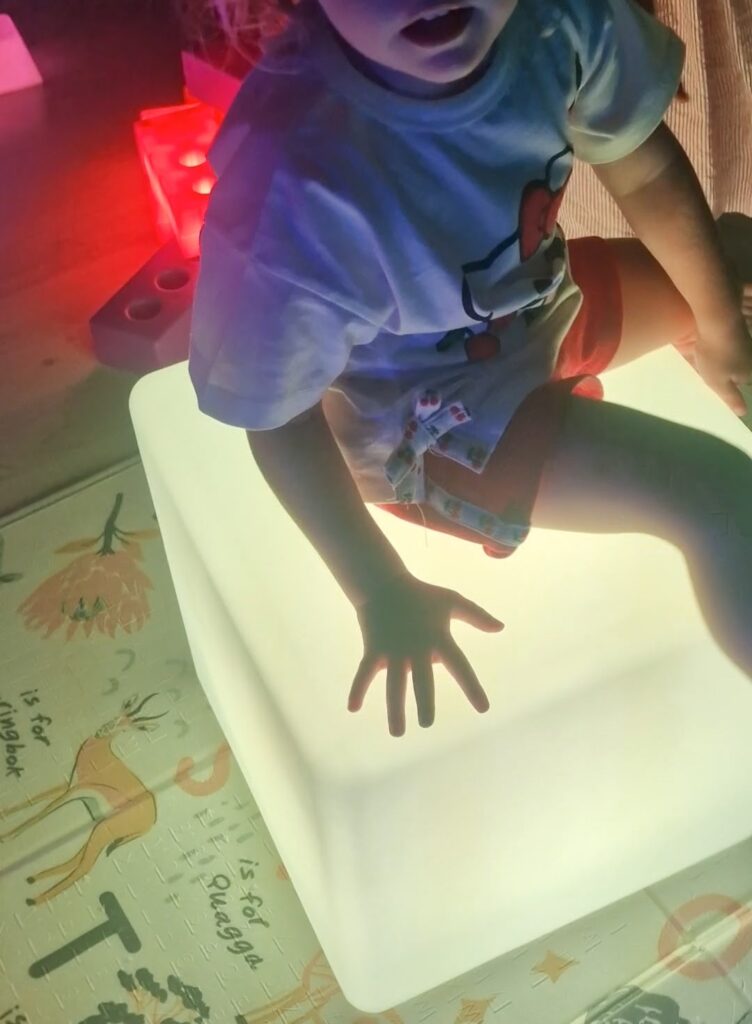
With crawlers and toddlers on the move, stay close and supervise throughout, especially around lamps and cables.
Keeping light play safe
Light play for babies should always feel calm and gentle, and a few simple precautions go a long way.
- Never shine light directly into your baby’s eyes. Avoid pointing torches at faces, and skip phone flashlights and laser pointers altogether.
- Keep it slow and soft. Fast flashing or strobe effects can be overwhelming. Choose lights that glow steadily or change colour gently.
- Watch for signs of “enough”. Turning away, fussing, yawning, arching or crying can mean your baby needs a break. Put the lights back to normal and have a cuddle.
- Check battery compartments. Make sure they are screwed shut. Button batteries can cause serious internal injuries within hours if swallowed. If you think your child has swallowed one, go to A&E (urgencias) or call 112 straight away.
- Skip the glow sticks. They are easy to chew open and aren’t suitable for babies.
- Keep cables and plugs out of reach. Fairy light wires, plugs and battery packs should stay well away from little hands. Use cool LED lights, never candles.
Light play at Little Senses
We use light in lots of ways in our classes. We darken the room and bring in specialist sensory lighting, from fibre optic cables to glowing blocks and a scenery projector. Little ones can then explore in a calm, cosy space.
Discovery Senses is for babies who aren’t crawling yet, with sensory play alongside gentle baby massage and yoga. Sensory Pioneers is for crawlers and toddlers, with themed sensory free play and you alongside your little one throughout. Both classes run in English in Marbella. We also run occasional Family Days for the whole family. Sign up to hear about the next one.
New to sensory play in general? Our post on why sensory play matters is a good place to start. Want to try light play for babies and toddlers in person? Book a single class and see how your little one gets on.